Monday, 8 January 2018

Haryana frames rehabilitation policy for people living in slums on govt land

Haryana urban local bodies minister Kavita Jain said on Sunday that the state government had framed Slum-in-Situ Rehabilitation Policy to provide residential facility to those who have been living in slums on government land in urban areas in the state. Chief minister Manohar Lal has reportedly given approval to the policy. The government would allot houses to such people living in municipal corporations, municipal councils and municipalities by developing colonies under the private-public partnership model.

Jain said the policy applied to slums identified under the Pradhan Mantri Awas Yojanasurvey to be conducted by the state government and situated on the Centre, state or urban local bodies land. She added that a private partner for slum redevelopment would be selected through open bidding process.

The minister said that the developer would pay rent to every household so that the beneficiaries should move to other location and construction will start. The rent for such households in municipal corporations of Gurugram and Faridabad would be Rs 3,000 per month whereas it would Rs 2,000 per month for other municipal corporations. Similarly, Rs 1,500 per month and Rs 1,000 per month would be the rent for all municipal councils and the municipal committees, respectively. The rent would be paid by the developer to the project beneficiaries till the date of handing over the project to the municipality concerned.

The ownership right over the unit allotted to beneficiary would be given after 15 years and during this time the unit would be given to the beneficiary on lease. The lease money would be Rs 20,000 for municipal corporations of Gurugram and Faridabad whereas it would be Rs 15,000 for other corporations. Similarly, Rs 12,000 would be lease money for all municipal councils and Rs 10,000 for municipal committees.


Source- ET Realty

Friday, 5 January 2018

NITI Aayog expects robust GDP growth in 2018-19

Although the reported numbers have seen a dip year-on-year, the Aayog on Friday said the growth would become more robust in 2018-19.
"The second half growth in 2017-18 has risen to 7 per cent, bringing the annual growth rate to 6.5 per cent. Economic activity has been picking up over the last three quarters and can be expected to strengthen in the coming period with the manufacturing PMI now reading at a five-year high of 54 per cent, and FMCG demand picking up briskly. Hence, the growth will become more robust in 2018-19," Aayog noted.
He further said the estimates assume significance in the wake of the fact that the higher second half growth came despite a weaning of public sector expenditures which had peaked in 2016-17 on account of the implementation of the recommendations of the 
As per data released by the (CSO) earlier in the day, the growth in during 2017-18 was estimated at 6.5 per cent, as compared to the growth rate of 7.1 per cent in 2016-17. Real at constant (2011-12) prices in the year 2017-18 is likely to attain a level of Rs 129.85 lakh crore, as against the Provisional Estimate of for the year 2016-17 of Rs 121.90 lakh crore, released on May 31, 2017.
On the other hand, Gross Value Added (GVA) at basic constant prices (2011-12) is anticipated to increase from Rs 111.85 lakh crore in 2016-17 to Rs 118.71 lakh crore in 2017-18. Anticipated growth of real GVA at basic prices in 2017-18 is 6.1 per cent, as against 6.6 per cent in 2016-17, the data revealed.
The sectors which registered growth rate of over 7.0 per cent are, public administration, defence and other services, trade, hotels, transport, communication and services related to broadcasting, electricity, gas, water supply and other and financial, and professional services.
The WPI in respect of the groups - food articles, manufactured products, and all commodities, has risen by 2.0 per cent, 2.6 per cent, 0.4 per cent and 2.8 per cent, respectively during April-November, 2017-18.
Meanwhile, the Index (CPI) has shown a rise of 3.0 per cent during April-November, 2017-18.

Source- Business Standard

Thursday, 4 January 2018

Natural gas, jet fuel may soon come under GST, but not petrol, diesel

Natural gas and aviation turbine fuel (ATF) may soon come under the Goods and Services Tax (GST), while real-estate, petrol, diesel and electricity will take more time, ET Now reported quoting unidentified government sources. Both aviation ministry and petroleum and oil ministry have made a strong case for bringing ATF and natural gas under the GST.
However, the government may wait for revenue to stabilise before bringing more items under the new indirect tax regime. States are likely to give nod for natural gas and ATF, while not in favour of bringing petrol, diesel under the GST.
In November, industry body FICCI has asked Finance Minister Arun Jaitley to bring natural gas under the GST. A top revenue department official told PTI that as the Centre and states are assured of revenue flows, natural gas can be the next big item to be included.
“To me, it appears that out of the 5 petroleum products, natural gas is an easier candidate for bringing into GST,” he said, adding that a 5% GST, equivalent to that being charged on coal, will benefit states in reducing the price of CNG as well as cooking gas piped into kitchens.
While Arun Jaitley pitched for bringing petrol and diesel under the GST as well, he said it was a decision to be taken by states. “We don’t need to amend any law if petroleum products are to be brought into the GST, but only after the council takes a decision is when it will be introduced,” he had said, adding that the council was awaiting a response from states.
The ‘one nation, one tax’ subsumed at least 17 different central and state indirect taxes under one umbrella to cut tax evasions and reduce corruption.

Source- Financial Express

Wednesday, 3 January 2018

No agreement for sale, no refund, rules MahaRERA

No agreement for sale, no refund, rules MahaRERADashing the hopes of over 2,500 home buyers, who have invested their hard-earned money in projects promoted by the Bhagtanis, the Maharashtra Real EstateRegulatory Authority (MahaRERA) has dismissed complaints of 15 home buyers ruling that in the absence of a registered agreement for sale, the provisions of Section 18 of Real Estate (Regulation and Development) Act (RERA) do not apply.

This group had booked flats in Bhagtani’s Serenity project in upscale Powai and was given only allotment letters that contained a clause saying their investments will be refunded with a 15% interest if project approvals do not come forth. Similar allotment letters were issued to buyers in Riyo (Mira Road), Sapphire (Dahisar) and Savannah (Kanjurmarg) housing projects.

In its order dated December 29, Adjudicating officer and Member, MahaRERA, Bhalchandra Kapadnis said, “Section 18 clearly stipulates that a promoter is liable to pay interest or compensation if he fails to complete or is unable to give possession of an apartment in accordance with the terms of agreement for sale.”

“The Section 18 clearly indicates that there must be an agreement for sale for invoking Section 18. The allottee gets a refund only when the promoter fails to complete the apartment in accordance with the terms of agreement for sale or he is unable to give possession on the date specified in the agreement. Therefore, in the absence of any agreement for sale, section 18 has no role to play. It is necessary to bear in mind that issuance of allotment letter is the first stage and execution of the agreement for sale is the subsequent stage,” said Kapadnis in his ruling.

‘Builders misused the Act’

“We are disappointed with the ruling. We had huge hopes that now that a regulatory body exists, they will take cognizance of our complaint. The promoter hasn’t signed the agreement with 90 per cent of the buyers in Serenity though many of us have paid nearly 30 per cent of the flat’s cost,” said Col Tej Kohli (retd), one of the 15 complainants who invested Rs 20 lakh in Bhagtani Sapphire project in Dahisar in 2012, but later transferred it for a 1BHK flat in Serenity.

“The promoters have registered only 1 building with MahaRERA to escape their scrutiny and lied to the authority that not a single of the 77 flats have been booked, whereas so many allotment letters were issued and money was collected,” a distressed Col Kohli added.

Manjit Singh, another complainant, told Mumbai Mirror, “The promoter demanded payments up to the first podium, and I paid Rs 40 lakh out of the Rs 70 lakh. Section 13 of RERA says that a promoter has to make an agreement if he accepts more than 10 per cent, but no agreement was made. So, why can’t MahaRERA take cognizance of our complaint then?”

Singh was also duped in a Unitech Mohali project where he paid nearly 95 per cent of the flat cost. But, following Supreme Court’s intervention, Unitech negotiated a settlement with him. “The builder has offered me an alternate flat at the rate given to me five years ago, and we have closed the issue. Just when I thought one issue is closed, this ruling has come. We will definitely appeal,” Singh said.

Source- ET Realty

Friday, 29 December 2017

More housing finance companies to heat up home loan biz

More housing finance companies to heat up home loan bizMUMBAI: A sharp increase in the number of housing finance companies (HFCs) is set to intensify the competition in home loans. According to ratings agency ICRA, the overall market size for housing finance is around Rs 15.3 lakh crore as of September 2017 and the overall share of HFCs is Rs 8.5 lakh crore.

Home loan growth, which has been the main driver of increase in bank credit, slowed down from 19% in FY16 to 16% in FY17 and further to 15% Y-o-Y for the 12 months ended September 2017. The HFCs’ loan portfolio has grown at a faster pace than banks on the back of the increase in the number of players — from 57 in 2013 to 91 in December 2017.

Several new groups have entered the mortgage business through a dedicated housing finance company. These include Piramal, Religare, Reliance, Aditya Birla Housing, Edelweiss and IndoStar Home Finance. Currently, HDFC, SBI, ICICI Group, LICHF and Axis Bank dominate the home loan market. Going forward, the other finance companies are expected to increase their share.

While the cost of funds is higher for non-banks, they are able to manage their spreads by lending to developers. With non-housing loan portfolio of HFCs growing at a faster pace, the share of housing loans in the overall HFC portfolio has declined to 67%.

“From an overall retail credit perspective (across lending groups), retail credit growth of housing finance companies was largely range-bound at around 20% over the period September 2016 to September 2017, while bank and NBFCs witnessed some decline in their retail credit growth post-demonetisation. The recovery was relatively better for banks, as it grew at about 17% Y-o-Y in September 2017, driven by the non-housing segment. However, NBFC retail credit growth was relatively lower at about 15-16% during this period,” said A M Karthik, assistant VP and sector head (financial sector ratings), ICRA.

According to an ICRA report, NBFCs’ share in the unsecured consumer credit (excluding microfinance) is likely to expand as more entities venture into this segment for product diversification and higher business yields.

Source- ET Realty

Thursday, 21 December 2017

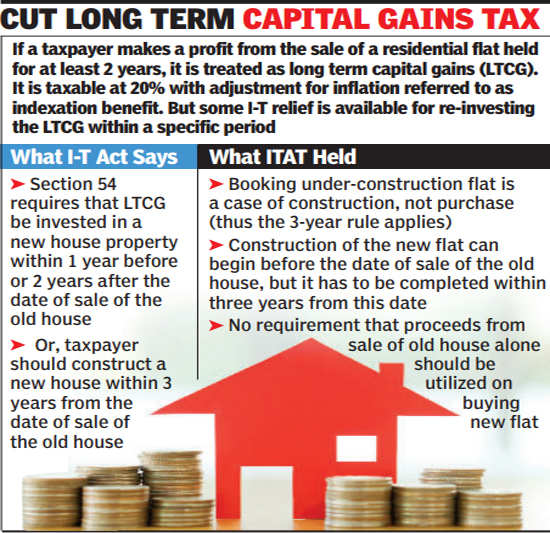
Booking under-construction flat not a purchase, merits tax relief: ITAT

MUMBAI: A taxpayer who books an under-construction flat and acquires it within three years of the sale of his old house will be entitled to a tax deduction, the Mumbai bench of the Income-tax Appellate Tribunal (ITAT) has ruled.

“Booking of a flat in an apartment under construction must be viewed as a method of constructing residential tenements,” said the December 18 judgment.

This ruling is important as tax relief on long-term capital gains (LTCG) accrued from sale of a house can be availed only if it is invested in another house within a specified period.

Booking under-construction flat not a purchase, merits tax relief: ITAT

Under section 54 of the I-T Act, the period prescribed for investing the LTCGs in a new house is two years from the date of sale of the old house. The tax benefit is also available if a new residential house is constructed by the taxpayer within three years from the date of sale of the old house.

In this case, the taxpayer invested LTCGs of Rs 78.4 lakh arising from the sale of his share of a Byculla flat into booking a flat in an under-construction building at Mumbai Central. He paid the builder Rs 1.04 crore in instalments prior and post the sale of the old flat.

The final payments were made subsequent to the sale of the old flat. Since the payments exceeded the amount of LTCGs, the taxpayer claimed the entire sum of Rs 78.4 lakh was deductible under section 54. In other words, the taxable component of the LTCGs was ‘nil’.

Since the old flat was sold on December 5, 2012, the taxpayer submitted that the time limit prescribed under section 54 (for constructing a residential house) was available up to December 2015. He pointed out that the new flat was acquired before this date. But the tax authorities treated the booking of a flat as a purchase, which is subject to a two-year limit.

Following earlier decisions of the Bombay high court and the tribunal itself, the ITAT agreed that booking of a new flat in an under-construction apartment should be considered as a case of “construction” and not “purchase”. The ITAT added that the construction can commence prior to the date of sale of the old asset. Earlier, judicial decisions of the Karnataka high court and Ahmedabad ITAT have also held that the date of commencement of the construction is not relevant, and it is only the completion of construction which is relevant for the purpose of section 54.

In this case, the taxpayer had booked the new flat much before the sale of the old flat. However, there was no dispute that he took possession of the new flat within three years of the sale of his old residential flat. Thus, the ITAT held that the time limit prescribed under section 54 had been met.

Lastly, regarding the payments made before the sale of the old flat, the ITAT observed that there is no requirement that the proceeds realised from the sale of the old house alone should be utilized. Thus, the deduction claimed by the taxpayer was allowed in full.

What ITAT said

The ITAT ruled that booking of an under-construction flat is a case of construction and not purchase

Its construction can start before the date of sale of earlier property, but it should be completed within three years from that date to be eligible for tax relief

Source- ET Realty