Wednesday, 23 August 2017

Govt reduces GST on work deals for affordable homes

The government has reduced GST rate on work contracts for affordable housing to 12% from 18% fixed earlier. But it is unlikely to have any impact on prices of affordable housing for buyers, industry experts said as GST rate for buyers to purchase a finished house remains at 12%.

In a notification issued on Tuesday, the government said GST on composite supply of work contracts for affordable housing up to carpet area of 60 sq metre in a project approved by a competent authority will be 12%, including the state GST.

CREDAI president Jaxay Shah said the new rate is only for work contractors. If a developer involves a work contractor for his project, his cost will be reduced by 6%. But in the affordable segment, developers construct projects themselves to be cost-efficient. Therefore, the cost for developers will remain the same.

And on top of that, buyers will continue to pay GST at 12% on affordable housings. Of course, he will get the credit for taxes paid on inputs.

In GST regime, when a developer sells a house to an enduser, GST will be calculated at 18% on the two- third value of the house. The net rate would be 12% of total price of the house. The abatement of one-third of the value of the house is given to adjust the land price, which neither comes under goods or nor services category.

Source- ET Realty

Tuesday, 22 August 2017

Govt panel on hiccups in Noida’s exit policy for builders

GREATER NOIDA: The state government has formed a committee, headed by Greater Noida Authority chairperson Rahul Bhatnagar, to deal with issues related to the Uttar Pradesh's Project Settlement Policy (PSP).

The move comes following the Noida Authority's proposal in July 2017 to extend the deadline for builders, opting for the policy, to submit their applications. Earlier, the deadline was June 15.

The committee also includes CEOs of Noida, Greater Noida and Yamuna Expressway authorities as its members.

According to officials, an order dated August 14, 2017, from UP principal secretary(industries) Alok Sinha has been circulated in the three authorities. "This committee will examine all issues related with the PSP, including extension of the policy date, amendments to the policy, if any, etc.," said Debashish Panda, CEO, Greater Noida Authority.


"Also, reducing the upfront payment plan, part surrender of land, financial plan for co-developers, forfeiture in a part land surrender deal and all such matters — which need clarification by builders participating in the PSP — will be addressed by the committee," Panda explained.

The UP government had approved this policy on December 15, 2016, to resolve multiple issues faced by builders and homebuyers. It is aimed at helping thousands of buyers get possession of their homes, besides allowing the three authorities to recover their land dues amounting to nearly Rs 30,000 crore.

While some realtors under the PSP have opted to return the land and exit from projects that have been stuck for long, some have opted for a rescheduled payment plan by paying 25% of their outstanding dues. Many others have come up with a co-developer who would help them finish their incomplete projects.

"Under the part land surrender plan, many clarifications have been sought regarding legal rights of co-developers, forfeiture of land and penal interest," said the CEO. "Each issue will be examined in details before arriving at a conclusion. Each clarification has to be submitted to the government in two weeks, i.e. by August 28," he added.

Source- TOI

Monday, 21 August 2017

Union govt to double Metro network in 18 months, add 4 new cities on map

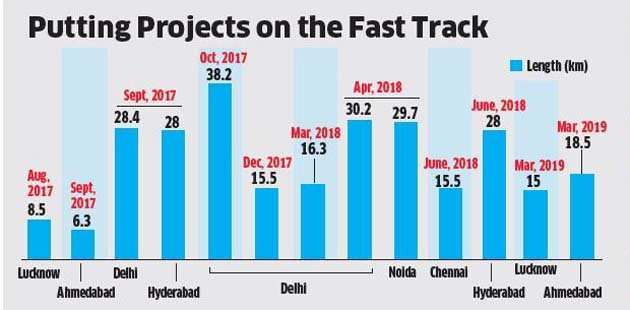
NEW DELHI: In a major fillip to urban transport, the Union government is all set to double the metro rail network over the next 18 months, adding four new cities to the metro map. The biggest gainers would be cities in BJP-ruled states, viz. Lucknow, Ahmedabad and Nagpur. Lucknow Metro would be the first off the block as it has received safety clearance and would be inaugurated within this month.

Election-bound Gujarat would get its first 6.3 km stretch in the capital city Ahmedabad next month. These two stretches would be followed by 28.4 km stretch in Delhi and 28 km in Hyderabad in September.

By March 2019, just two months ahead of parliamentary elections, 19 new sections in nine cities would be commissioned, adding 313 kms to the 370-km metro network. This translates to 313 kms made operational in 19 months as compared to 370 kms made operational over 33 years in eight cities since the first metro service began in Kolkata in 1984.

This is expected to be a major election pitch in urban centres. A senior ministry of housing and urban affairs official told ET, “Our cities are grappling with traffic jams and people are spending a lot of time on the roads. At such a time an expansion of comfortable metro network comes as a fillip to public transport. This has been aided by an increase in budgetary provision for metro rail projects.”

Union govt to double Metro network in 18 months, add 4 new cities on map

As per statistics provided by ministry of housing and urban affairs (MHUA), there has been a 158%hike in budgetary provision for metro projects during the last three years over the previous three years under Congress-led UPA government.

The budgetary provision between 2012 and 2015 for metro projects was Rs 16,565 cr, which has been increased to Rs 42,696 crore during 2015-18. At present, metro services are available in Delhi (217 kms), Bengaluru (42.3 kms), Kolkata (27.39 kms), Chennai (27.36 kms), Jaipur (9 kms), Kochi (13.3 kms), Mumbai Metro Line 1 (11.4 kms), Mumbai Mono Rail Phase 1 (9 kms) and Gurugram Rapid Metro (11.60 kms).
 
Source- Economic Times

Sunday, 20 August 2017

UP housing board’s revamped website a hit

The state housing board’s revamped website for payment of instalments for property comes with various features. Available only for residents of Lucknow as of now, the website, will soon be available in KanpurGhaziabadMeerut and Varanasi.

Owners can pay for properties bought from UP Housing & Development Board (UPHDB) through the website and see real-time realization of payment in their ledger account.

Earlier, in the offline or e-challan method, a consumer had to take out a print of the e-challan from UPHDB’s older website and carry a draft or cheque to the bank to deposit the amount. After the payment was accepted, it would take several days to be reflected in the person’s account. Under the new website, payments will be updated instantly.

The board has included around 25,000 properties under this system. These include Awadh Vihar Yojna on Sultanpur Road, Vrindavan Yojna on Rae Bareli Road and a project in Rajajipuram.

The website will have language options of both Hindi and English. An important feature is the audio facility for visually impaired people. Such a person can turn on the audio to listen to the online payment process. Security features for payments have also been enhanced.

The website was launched on Independence Day and has received more than 2,600 hits till now. The board said the number of online payments has doubled in comparison to the older version in the same time with a collection of around Rs 26.7 lakh in just one day.

So far, only around 3500 people in Lucknow are using the online method to pay for their property. The board aims to bring all allottees (around 20,000) under the online payment method. Though the initiative was planned a year ago, the execution took considerable time as it had to meet the security standards of standardization testing and quality certification—a government organization working under the ministry of electronics and information technology.


Source- ET Realty 

Friday, 18 August 2017

UP Housing & Development Board launches website as per GoI parameters

LUCKNOW: UP Housing & Development Board (UPHDB) has launched its new website called ‘upavp.in’ whose latest features will make the online payment more convenient and secure for its allottees. The website has been authorised by the Guidelines for Indian Government Website) and contains all the features which Centre mandates for every website operating in Indian domain (.in).

Currently, the features can be accessed only by Lucknow residents as only city’s properties have been included but gradually UPHDB’s properties in districts like Kanpur, Ghaziabad, Meerut and Varanasi will also be included under this. Currently, the board has included around 25000 properties under this online system which consists of Awadh Vihar Yojna on Sultanpur Road, Vrindavan Yojna on Rae Bareli Road and Rajajipuram project.

So far only around 3500 people in Lucknow have been using this online method to pay against their property while rest were still resorting to offline payments. The board aims to bring all these allottees (around 20000) under this online payment method soon. Though the initiative was planned a year ago, its planning took considerable time as it had to meet the security standards of STQC (Standardisation Testing and Quality Certification) — a government organisation working under Ministry of Electronics and Information Technology.

The new website will offer many convenient features to the allottees like language option of both Hindi and English and also real time realization of payment in their ledger account. Earlier in offline or e-challan method, a consumer had to take out the print of e-challan from UPHDB’s older website and carry draft/ cheque to banks to deposit the required amount against their property. Though the payment was accepted in banks, it took many days to realize in the person’s account. He faced a lot of inconvenience due to this. But the new website has made this easy by instantly updating the payment in account.

Source- ET Realty

Thursday, 17 August 2017

Real estate firms reach out to PM on RERA

Real estate project developers have sought the intervention of Prime Minister Narendra Modi to successfully implement the Real Estate Regulation & Development Act (RERA).
In a letter to the PM, the Confederation of Real Estate Developers’ Associations of India (CREDAI) also sought more clarity on the definition of an ‘ongoing project’ and requested for the expedition of processes from the state and central authorities.
CREDAI said that the lack of appropriate infrastructure and non-notification of RERA rules have led to the majority of developers not being able to register their projects on time. This is leading to delays and a loss of revenue for the State and Central governments as well.
CREDAI said that a large number of States have not yet appointed a regulator, while some appointed them recently.
Source- Business Line 

Wednesday, 16 August 2017

Capital gains can be invested more than once for new house

MUMBAI: The Income-Tax Appellate Tribunal (ITAT) has held that a taxpayer can invest capital gains for the second or third time towards the same ‘new’ house property. Tax benefits cannot be denied on this ground, provided the cost of the new house is within capital gains that have arisen to the taxpayer.

ITAT also held that as the new property was under construction, it cannot be counted towards the number of houses already owned by the taxpayer.

Various provisions of the Income-Tax (I-T) Act grant a tax benefit, where long-term capital gains (LTCGs) arising out of a sale of certain assets are invested in acquiring a new house property. To the extent of investment in the new property, the taxable component of LTCGs is reduced, which results in lower I-T outgo. But if the taxpayer owns more than one house, other than the ‘new’ residential property, on the date of transfer of the original assets, the I-T benefit is not available.

It is not uncommon for taxpayers to sell more than one asset to buy a larger accommodation or to purchase one in a relatively more tony area. ITAT Delhi bench’s decision early this month will support I-T deduction claims of taxpayers.

“ITAT has rightly held that the new house was not complete, so it could not be regarded as a house already ‘owned’ by the taxpayer. Also, there is no bar on claim on exemption of more than one capital gain in respect of investment in one house, which ITAT upheld. The only aspect taxpayers need to keep in mind is meeting timelines for acquisition of the new house,” said Gautam Nayak, tax partner at CNK & Associates.

This case decided by ITAT relates to section 54F, which provides for I-T deduction where LTCGs arising from sale of non-residential property are invested to acquire a new house property. Tax experts said the same tenet will apply to section 54 too, which covers investment of LTCGs arising from sale of a residential property in another house property. LTCGs arise where property held for more than three years is sold for a profit.

Mohinder Kumar Jain, whose case was heard by ITAT, had sold five properties and invested the LTCGs, for construction of a house at Mehendi Farm. He claimed a deduction of Rs 1.59 crore under section 54F in his I-T returns for 2010-11.

The I-T official disputed this claim and said a deduction of Rs 47.84 lakh had been claimed earlier by Jain under section 54F for construction of the same house at Mehendi Farm. This claim had been allowed by the I-T authorities for 2008-09. The I-T official contended that on the date of sale of these five properties, Jain owned more than one residential house (at Vasant Vihar and the property under construction). Thus, he denied the I-T benefit that was sought by the taxpayer. When the dispute reached ITAT, it decided in favour of the taxpayer.

Source- ET Realty